

Credit Weekly: The Privacy Premium
Jane Street is paying nearly $200 million a year for a smaller audience

While the leveraged market drifts into its August lull, Jane Street just paid up to leave the public market entirely, telling us what privacy costs. The firm raised $14.6 billion privately in a group led by JPMorgan, with PIMCO in the book, using roughly $11 billion of it to retire its public debt.
The new debt costs about ~311bps vs. its existing debt at ~152bps. That works out to roughly $175 million a year of incremental interest, plus about $200 million of one-time make-wholes to exit early. That is the bill, paid voluntarily, by one of the most profitable trading firms on earth.
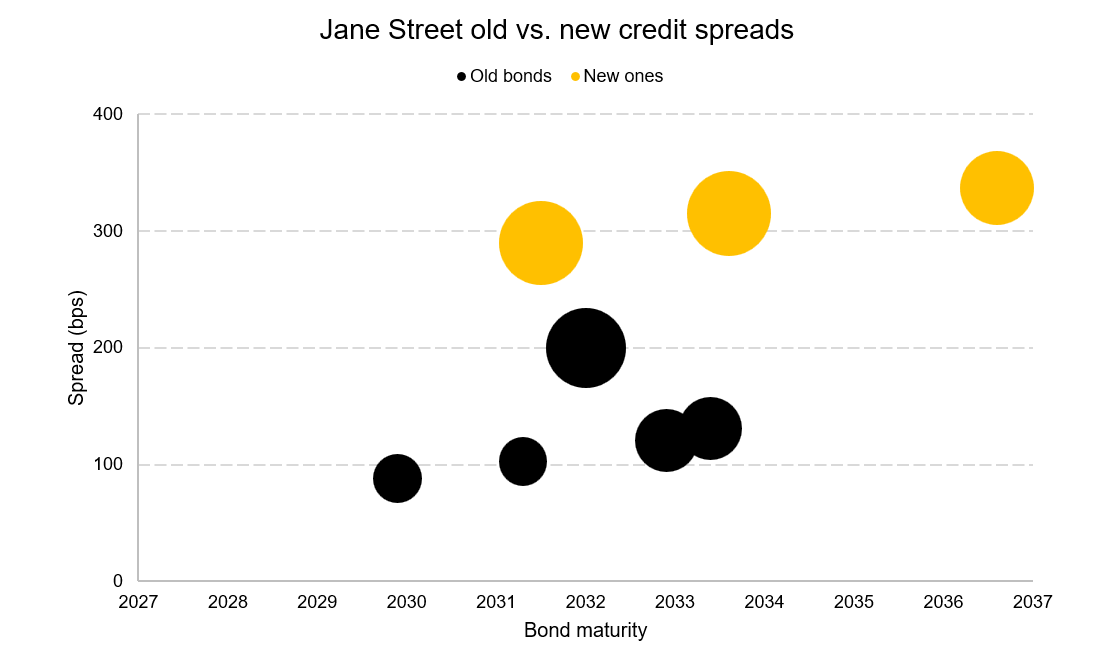
What did the money buy? It bought a smaller audience. A private structure means the real financials go to a handful of lenders instead of a broad bondholder base. And this was not rescue financing, since Jane Street had access to the public market and voluntarily paid nine figures a year to reduce the number of creditors holding its financials.
Days later, a roughly $15 billion July trading loss reached the press through an employee note. The leak illustrates the limit of the arrangement. Jane Street could reduce the number of creditors holding its financials, but it could not control everyone else holding sensitive information.


Privacy Is the Product
One of the primary advantages of private credit that public markets cannot replicate is control over the audience. Borrowers buy it as confidentiality. A private company hands its real numbers to a few lenders under NDA instead of circulating them across a broad bondholder base. For a trading firm whose counterparties spend all day reverse-engineering its positions, that’s worth real money, and Jane Street just told you exactly how much.
Investors buy the same feature under a different name. Loans that never trade produce marks that barely move, so the return stream comes out looking uncorrelated and calm. Asness calls it volatility laundering, and he’s mostly right. But notice it’s the same feature the borrowers are buying, since an asset with fewer observers generates fewer prices and reports less volatility as a result.
Opacity was never an accident the industry tolerated. Both sides of the market have been paying premiums for it since the asset class’ inception.
Now Look at the Project List
Hold that against what the largest managers spent the same month building. Apollo started marking its IG direct lending daily on July 1 and says the full credit book carries daily prices by early October, explicitly so the assets can sit inside 401ks and daily-NAV products. Apollo is also the anchor client for ICE’s new persistent identifiers, built so a private loan can be tracked through amendments and transfers the way a CUSIP tracks a bond. And Evercore counted $20.4 billion of credit secondaries in the first half, double last year, as the transfer market institutionalizes.
None of this creates a genuinely public market. Apollo can mark a loan daily without disclosing the borrower’s financials, a daily-NAV vehicle can strike a value without showing anyone a loan-level clearing price, and ICE describes its identifier system as permissioned data sharing rather than an open tape. What the industry is building is legibility for investors, meaning more observable portfolio values and more transferable assets, while the borrower’s numbers remain behind the wall. The new infrastructure may preserve borrower confidentiality, but it still erodes the price opacity that produced the smooth returns investors were buying.
Why They Can’t Help It
The motivations are rational, and that’s what makes this interesting. Institutional fundraising is maturing, and the wealth channel just spent two quarters proving it will redeem. Non-listed BDCs raised $2.0 billion in Q2, down 82% year over year, while recording roughly $3.8 billion of net outflows. That implies approximately $5.8 billion of redemptions, nearly 3x gross fundraising. Getting into retirement accounts, insurance ledgers, and ETF wrappers is the answer to that problem, and those systems cannot hold an asset with no number attached. Meanwhile the redemption queues need a secondary market, because the alternative to selling portfolios is gating, and gating ends a franchise.
So the liquidity infrastructure gets built out of necessity. The problem is that liquidity is made of information. BlackRock TCP transferred roughly half its debt book into a Pantheon-backed vehicle this month through a transaction expected to reduce its NAV by 10.4%, and that adjustment is now public and quotable. Ares reportedly had to roughly halve a planned continuation vehicle rather than accept the bids, suggesting that the bids sat below the values at which the assets were being carried. Every disclosed transaction creates a reference point that did not exist before.
Why Private Credit Secondary Trading Will Struggle
I’m skeptical private credit ever develops a broad, continuously observable tape outside the largest quasi-syndicated names. Trading needs strangers who can price the risk, and just getting access to the information you need to price the thing is the challenge in itself. Public markets solved that problem with mandatory disclosure, while private credit is organized around limiting it. What’s emerging instead is a permissioned market, the way syndicated loans trade through gated data rooms and private-side walls, where a small club of repeat buyers gets enough information to transact and outsiders still can’t independently price the assets.
Look at who actually transacts. Pantheon could bid the TCPC book because it already held exposure to more than 80% of the underlying borrowers, and while it still had to underwrite the portfolio, it walked into the data room with a head start no outsider could replicate. Meanwhile, 83% of Evercore’s secondary volume is GP-led, and its report notes buyers are receiving more granular borrower information, which is the tell. The market that’s forming runs on permission, and the only party who can grant it is the manager. ClearPar settles your trade faster, but it does not get you the borrower’s monthly reporting package, and without that you are just guessing.
So the likely end state is the awkward one. There will be enough prints to embarrass the marks and break the smoothness allocators were paying for, without participation ever getting broad enough to make the market genuinely liquid. The new infrastructure quietly kills the calm that was the original product, and the exit it advertises never fully shows up.
The Bifurcation
The likely result is a split. Genuine confidentiality becomes a specialty product for borrowers willing to pay for small lender groups and concentrated risk, and Jane Street just set the opening quote at ~159bps over the public alternative. Commodity direct lending moves the other way, toward standardized identifiers and reference prices, because broader distribution requires them, and its pricing converges toward public benchmarks as the information gap narrows. The direct lending premium over BSLs at 149bps is already at the tightest of this cycle. As ordinary direct lending becomes more observable and transferable, that premium should continue converging toward public-market levels.

The sorting question for allocators is whether their manager controls something scarce or produces something easily replicated. Jane Street’s lenders provided confidentiality to an unusually valuable borrower through a tightly controlled lender group. Another SOFR+475 sponsor unitranche is much easier to replace.
That is where private credit is heading. Marks get challenged long before exits become dependable. Jane Street is paying nearly $200 million a year to shrink the audience for its financials.
Hiring in Credit?

Market Performance
High Yield Primary
Secondary Movers
JBI Bulletin Board

1) Now Hiring:
I’m hiring for a variety of roles, full-time and in-person. Reach out with a short note on your background, or see the careers page.


