

Credit Weekly: What If They Just Keep Borrowing?
What happens when the biggest borrowers stop caring what money costs

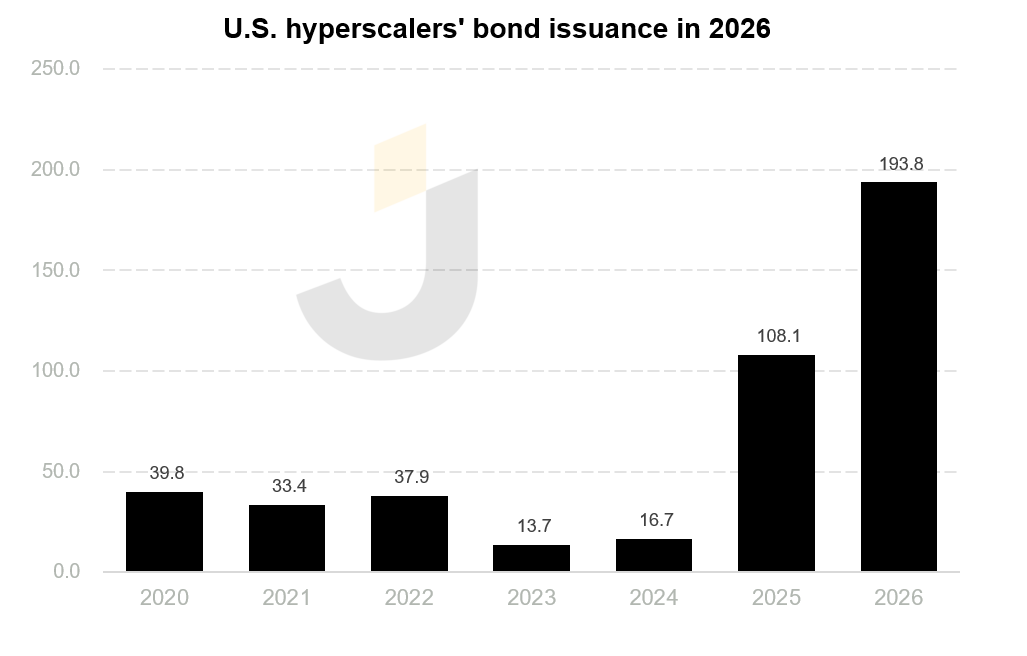
Google came to the bond market last week with another massive deal. You may not have noticed because these deals have become all too common. The hyperscalers show up week after week, size gets done, each deal on its own looks routine, and everyone goes back to their screens. It’s only when you add them up that the picture changes.
Hyperscaler capex for 2027 is tracking as high as $1.2 trillion. Six months ago that number was materially lower. Debt issuance is projected to be around $250 billion for 2026, and the street is penciling in $400 billion for next year. Meanwhile the 30-year sits at 5.20%, the highest since 2007, with real yields pushing 3%. The government shows no sign of spending less, and even fewer signs that the cost of borrowing enters the conversation at all.
A government running a deficit doesn’t get to skip an auction because the coupon looks ugly that week. The deficit gets funded whether the long bond is at 4% or 6%. And a hyperscaler chasing the AI race isn’t pausing spending over 50bps.
So what happens to everyone else when the two most price-insensitive types of borrowers just continue to borrow?
Issue Sponsored by 9fin:

AI is driving one of the largest capital allocation cycles the credit market has seen.
But the opportunity is creating new risks across software, infrastructure and private credit — from hidden lease commitments and data center financing to changing SaaS economics and portfolio exposure.
Our new whitepaper explores:
Capital allocation into AI credits
Risks of massive AI commitments
How AI is sorting the credit universe
New economics of SaaS businesses in the world of AI
Private credit’s AI explosion and implosion
Built using 9fin’s proprietary data, market expertise alongside 9fin AI Chat, it shows what’s possible when deep credit intelligence and purpose-built AI work together.
The Textbook Version
Under textbook theory, the cost of capital does the disciplining. A developer models a project, the financing costs 200bps more than it did 2 years ago, the projected IRR slips below the hurdle rate, and the project dies. Multiply that across every borrower in the economy and you have the main way rate hikes reach the real economy. Rates rise, marginal projects stop clearing, and demand cools.
These factors matter less to the two borrowers at the top of this market. The government’s case is obvious. By the time Treasury shows up to fund a deficit, the financing requirement is a quantity and not a decision. The hyperscalers are the more interesting example because they aren’t even running the calculation. The spread of their expected returns over any plausible cost of debt is enormous. Even that undersells it, because the cost of capital isn’t really in the investment equation at all. Capacity you don’t build this cycle is capacity a competitor locks up, along with the power, the land, and the customer. In a race for a market where winner takes most, incremental financing cost does not deter the investment decision.
They also sit increasingly at the top of the credit universe by size and duration. Hyperscaler and AI-related paper was roughly 3% of the IG index a year ago. It’s about 6% now, and Amazon alone just became the 5th-largest issuer in the entire index, behind only the 4 major banks. This supply is duration-heavy, with data center leases running 20 to 40 years and much of the debt termed out to match.
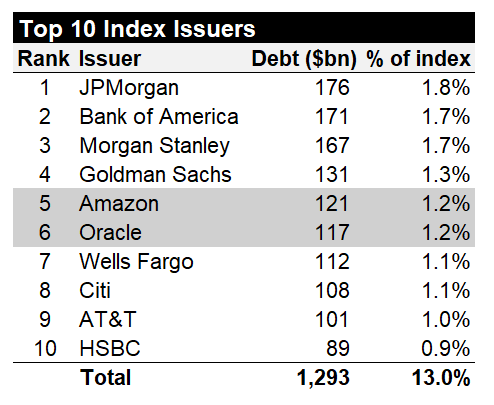
So a growing share of a rising long-end market belongs to borrowers like these, and the level they clear at becomes the reference point everyone else has to price against.
The New Issue Concession
Start with hyperscaler spreads. The complex has been backing up for months, sitting 20bps+ wider YTD against an IG index that is flat, with the long end leading the move. That’s old news by now. What’s newer is that the new-issue concessions are widening too.
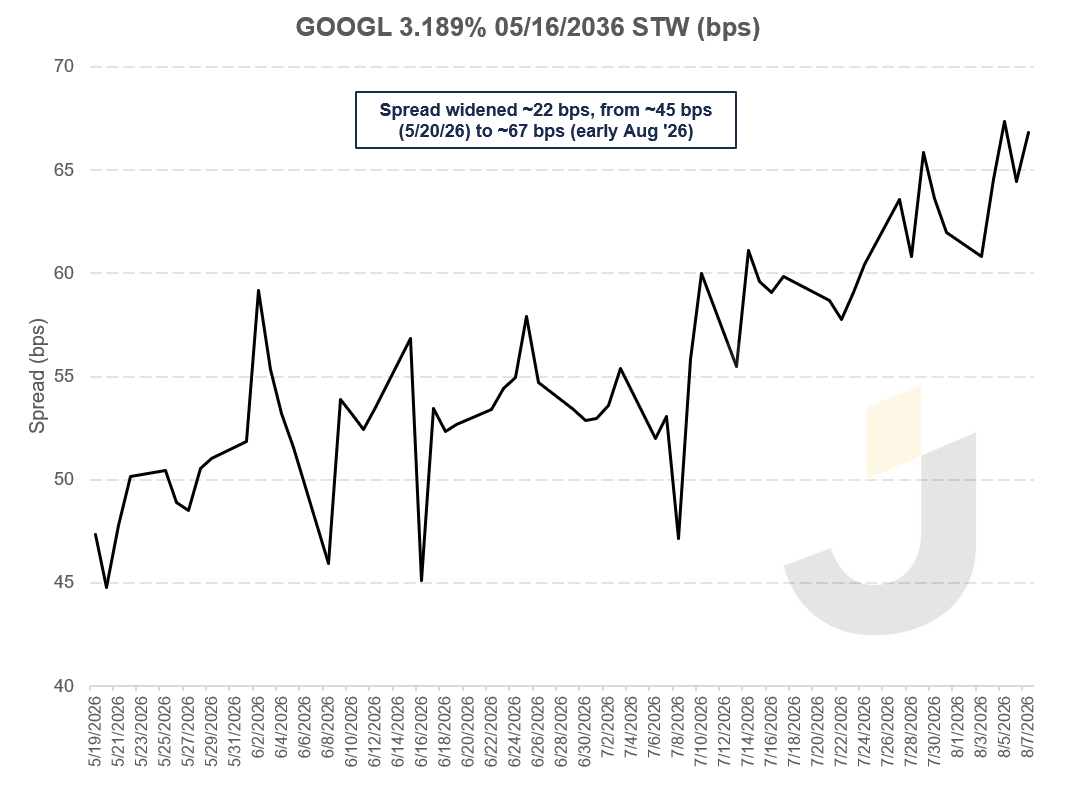
Take Alphabet’s deal from last week. Demand was enormous, with the book peaking among the largest on record, and the deal was walked in meaningfully from IPT and traded well on the break. It still paid a double-digit concession. The same borrower paid essentially nothing on its February print and a single-digit concession on its euro deal in the spring. The NIC keeps stepping up, and the borrowing plan hasn’t moved an inch in response.


The early-summer jumbos show the same repricing from the other side. Amazon, Nvidia, and SpaceX all cleared fine when they came, with concessions that looked normal at the time. Then the supply kept coming, the whole complex backed up underneath them, and that paper still sits wide of launch, in some cases dramatically so.
Nothing about those credits changed. The market level did, and each new deal pays whatever the level is on the day it prices. That’s how a concession that cleared in June becomes a double-digit one by August. Issuers have started paying in other currencies too. Alphabet’s deal came wrapped in a pledge that it’s the last dollar print of the year, Meta promised the same in April, Oracle in February, and somewhere between $50 and $60 billion is queued for after Labor Day, a number that would be bigger except some issuers were asked to wait.
Now run that forward. This summer already gave us the exchange rate, with roughly $75 billion of unexpected supply moving the complex about 15bps. Street estimates near $400 billion of issuance next year work out to something like 4 jumbo prints per major issuer. If that sensitivity holds even loosely, might we see another 30-50bps of spread purely from a supply re-rating? Each round would eventually attract its own buyers, but it at least raises the question.
The problem is now long-duration IG credit gets compared to the hyperscaler curve, and every round of supply moves that curve wider. A credit that looked fair value against Alphabet in the spring looks rich against Alphabet today, and nothing about that credit changed either.
The Relative Value Question
Relative value is how this reaches the top of the market, but it’s only half the transmission, because the two borrowers press on different components of the all-in yield. Treasury supply pressures the underlying rate. Hyperscaler supply pressures the spread above it, and the capacity of the investor base absorbing it. Everyone else inherits some combination of the two, depending on what they benchmark to.
Play the comparison out at the single-name level. Alphabet just paid T+85 for 10-year money and T+130 for 40-year, from a balance sheet holding $162.5 billion of cash and securities against $101 billion of debt. Now put a cyclical industrial BBB next to it, a business with real leverage, real cyclicality, and earnings that shrink in a downturn. A PM choosing between the two isn’t stretching for the BBB’s extra spread when the AA+ alternative holds more cash than the BBB’s entire EV and brings a new deal every quarter to buy it in. So the BBB’s refinancing cost drifts higher without the BBB doing anything wrong, because the alternative sitting next to it in every portfolio review keeps getting cheaper.
The rate component is also where the rate-sensitive economy lives. Housing and everything mortgage-adjacent run on transaction volume that dries up every time the 10-year backs up. Commercial real estate is rolling maturities struck at 4% coupons into a 5-handle long end. For most of these borrowers, the level is being set by a borrower whose funding needs have nothing to do with housing starts or cap rates.
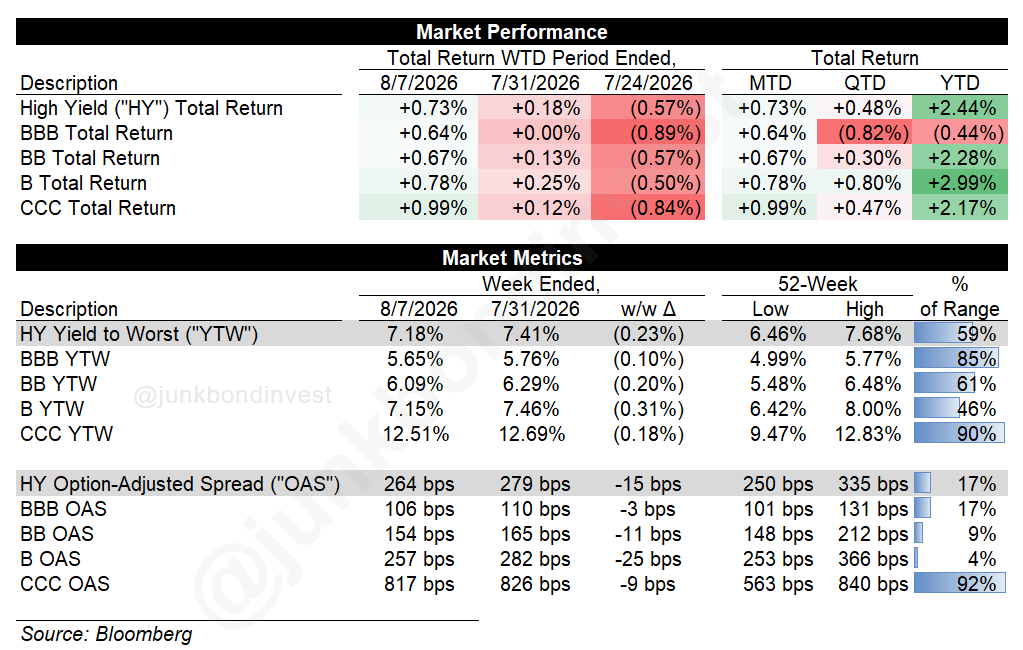
You can see the split inside high yield itself. The aggregate index looks fine, with spreads in the 260s and nothing to worry about at the headline. But the aggregate is increasingly a quality index, dominated by the BBs. Look underneath and the CCC bucket is widening out on its own, because that’s where the junk actually lives, the disrupted business models and the levered vintages that can’t grow into the new curve. The index averages the two into a number that describes neither.
How Does This Clear?
Where this goes, I don’t know, and I don’t think anyone does yet. But here are a few ways I’ve been thinking this could play out.
One version is that the squeeze eventually wins. Treasury keeps the underlying curve elevated while hyperscaler supply pushes the corporate complex wider, the rate-sensitive economy meets a higher hurdle rate all at once, and enough investment and refinancing gets curtailed that the slowdown goes economy-wide. Perhaps even dragging us into a recession. In that world, the buildout will have exported its financing cost onto borrowers who never asked for the exposure.
Another version is that the AI side just gets big enough that it doesn’t matter. If the revenue and productivity gains behind the capex arrive anywhere near the timeline being underwritten, the growth at the top could swamp the drag on everyone else, the way a handful of large caps can carry an equity index while breadth rots underneath. The aggregate numbers could look fine for years while the median borrower quietly pays more for money, because the index no longer represents the median borrower.
The third version is nothing happens. Spreads cheapen until the paper finds its buyer, which is how credit usually clears. Issuers stagger the calendar, lean harder on leases and private placements, and pay up when they must. Treasury terms out its bill-heavy funding gradually instead of all at once. The economy absorbs a higher cost of capital the way it absorbed 2022, unevenly and without an event. That path isn’t painless either, just the one where the rate-sensitive economy lives with a structurally higher curve for years and nobody ever gets to point at the moment it happened. The “K-shaped” economy and credit markets live on.
All three fit the numbers today, and that’s what makes this hard. The variables that would sort them can’t be observed yet, whether the AI capex cycle monetizes on the timeline its financing assumes, and how much widening it takes to pull new capital in before anything breaks.
Easing Into Supply
One more scenario, since it’s the one I keep coming back to. Say the first version starts playing out and the bottom half of the K breaks while the top half keeps spending. The pressure to cut turns political long before it shows up in the aggregate data, because the aggregate data is the average of a boom and a recession.
So the Fed cuts. The part we haven’t lived through is what the cut does to the long end. Easing into record supply doesn’t have to rally 30-year bonds. It can push long yields higher, as the market adds back inflation risk and term premium at the exact moment the deficit is growing and the hyperscalers are still printing. There’s already a preview. The September 2024 cut was followed by a roughly 40bps increase in long yields over the following month. And on Friday, one of the worst payroll misses of the cycle bought the 10-year all of a few basis points. Easing has not produced a durable long-end rally this cycle, and growth scares barely move it.
Play that forward and you get something strange. A recession in half the economy, cuts at the front end, and a long end that backs up anyway. The hedge every portfolio counts on, long duration paying for the credit losses, has to clear a heavier calendar than in any recent cycle to work. And the borrowers most dependent on term financing get far less relief than the cuts imply. Housing still prices off the mortgage and Treasury markets. Fixed-rate corporates still pay the term yield plus whatever spread the weaker economy demands. Floating-rate borrowers get some immediate base-rate relief, but wider spreads and thinner refinancing availability can eat most of it. The bottom of the K breaks, the Fed responds, and the response steepens the curve on top of the borrowers it was meant to help.
I’m not predicting this per se. If the long end rallies hard through the next few soft prints and September’s expected supply clears flat, the worry is misplaced. But until then, one question is worth sitting with. What’s the right price for duration when the seller doesn’t care what you pay?
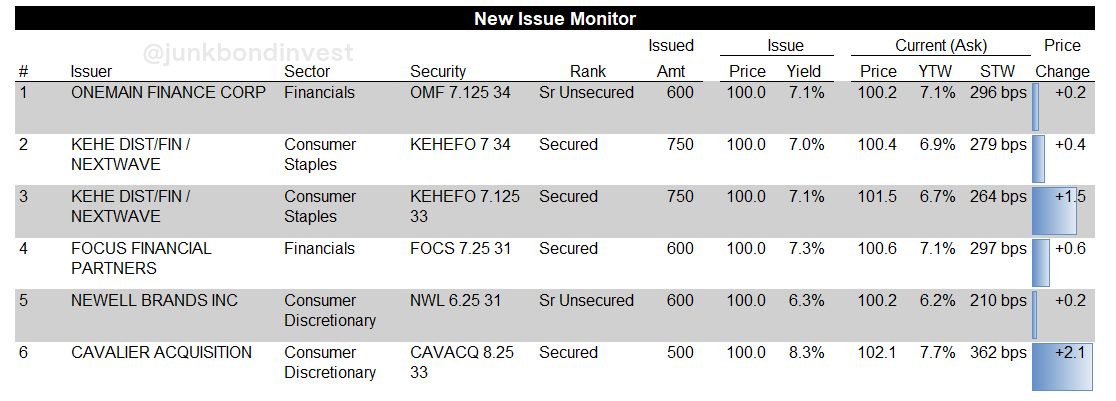
High Yield Primary
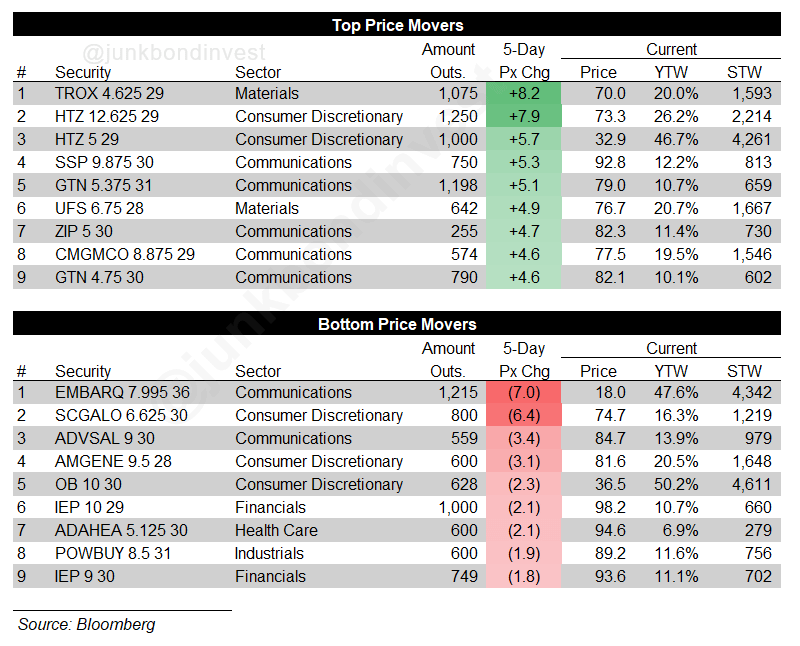
Secondary Top Movers
JBI Bulletin Board

1) Now Hiring:
I’m hiring for a variety of roles, full-time and in-person. Reach out with a short note on your background, or see the careers page.


