

Credit Weekly: Which Market Is Following Which?
For borrowers who live in the capital markets, the price of capital is a fundamental
Credit investors are supposed to be the “smart money.” They underwrite to cash flows, take fundamental views, and sit senior in the cap stack where the upside is capped so the focus is on downside protection. When bonds move and spreads widen, it’s supposed to mean something has fundamentally changed with the business.
In capital-intensive companies that depend on repeated market access, credit can respond to equity price action even when the initial equity move contains little new information about the business. The bonds follow the stock. The stock reads the bonds as confirmation. Each step is defensible on its own, and the loop repeats until something breaks.
The downside case, for any capital markets dependent business, is the same. They cannot access capital at all. That is where a market spiral like this ends if it ever runs far enough. Just ask any distressed issuer. Each market has reached a verdict partly informed by the other.
This raises a question about what happened this week. What happens when bond spreads, increasingly driven by equity beta, move on equity swings that might have nothing to do with fundamentals? When the equity move is driven by a liquidation of a market participant and the bonds move alongside that? Does it create an opportunity or a trap?
The CoreWeave Example
CoreWeave expects to spend more than $34 billion this year. First-quarter revenue was $2.1 billion vs. cash burn of $4.7 billion.
The loan market repriced that in July. CoreWeave came on July 20 asking for $2.6 billion, launched at 425-450 bps at 99 cents and cleared Friday at 550 over at 97. Lenders ended up around 10.4% where they were first shown something in the mid-8s.


Traditional corporate lending focuses on operating cash flow: estimate EBITDA and normalized CapEx and determine how much debt the business can service. The share price is generally the equity’s problem.
That framework does not work particularly well here. CoreWeave must buy, install, power and cool GPUs well before the associated contracts generate enough cash to support the investment. Spending runs far ahead of the revenue that is eventually supposed to pay for it, which means the gap between operating earnings and cash available to service debt is the entire debate.
The financing therefore comes in layers, and the layers are not equally exposed. Secured debt is sized against contracted cash flows from named customers, with collateral and structural protections behind it. Parent-level unsecured debt depends far more on residual enterprise value and on the company’s continued ability to raise capital. Equity absorbs the first loss.
Some of that capital does not yet exist. CoreWeave will need to return to the debt markets repeatedly, at prices that cannot be known today. A lender financing the current buildout, particularly at the parent, is therefore underwriting not only the existing contracts and assets, but also the company’s future access to capital.
That makes the share price relevant to the credit. If the stock falls by a third, an equity raise becomes more expensive or more dilutive, reducing flexibility for the company even if the operating outlook has not changed. Wider credit spreads can reinforce the problem by raising interest expense and shifting more of the funding burden back onto equity.
This is how equity volatility can migrate into the credit. Each step makes sense in isolation. The risk becomes clearer when the entire financing sequence is underwritten at once.
Forced selling distorts the signal
Unless you’ve been living under a rock, you’ve been following the Situational Awareness story from last week. The fund was long AI infra companies and short the software companies it expected AI to displace. The two sides of the trade appeared diversified, but both depended on the same underlying assumption: that AI capabilities would continue compounding quickly and that the economic consequences would follow.
When sentiment turned, the infrastructure longs fell while the software shorts rallied. The fund reportedly operated with leverage as high as four times.
Losses produced margin calls. The fund was near $45 billion at the beginning of July and had fallen to roughly $10 billion by Thursday, when Citadel acquired the remaining public equity portfolio in a block. BofA, GS, and JPM had reportedly been working through the positions before then.
On Friday, after the forced selling had largely ended, CoreWeave rose as much as 23% intraday. In Seoul, where several of the memory manufacturers associated with the same trade are listed, the KOSPI rose 18%, its largest one-day gain on record. Credit spreads across the cohort retraced alongside the stocks.
One trading session reversed a portion of the month’s decline. The operating outlook had not changed by a comparable amount overnight. What changed was the supply of stock for sale.
Credit and equity start confirming each other
CoreWeave’s stock declined while a leveraged holder was liquidating. Credit investors watched the equity cushion shrink and demanded more spread, which was a reasonable response given the company’s dependence on future capital. Equity investors then treated the widening in credit as confirmation that the deterioration was fundamental and sold further.
Once the liquidation ended, the stock rebounded and credit followed it back. Neither market was necessarily expressing a fully independent view. Each was using the other’s price action as evidence.

Some of the widening had nothing to do with the equity. Treasury yields backed up through the month, the volume of AI-related supply hitting the market kept building, and the sheer amount of future financing this cohort requires is a reasonable thing for lenders to reprice on its own. Separating those effects from the technical pressure is difficult in real time and probably impossible with precision after the fact.
The underlying demand signals also moved in the opposite direction for much of the month. The Mag7 companies buying the compute raised their spending guidance while the cost of financing that capacity increased. If the selloff had reflected a straightforward deterioration in demand, those two measures would normally move together. Instead, demand expectations rose while capital became more expensive, largely driven by supply rather than fundamentals.
That does not mean credit should have ignored the move. For a borrower dependent on continuous market access, the price of capital is itself a credit fundamental. Wider spreads increase the cost of the next financing, potentially force projects to be resequenced and increase the amount of equity required. A market-driven repricing can eventually produce a real deterioration in the credit. Still, there is something unusual about a senior claim repricing because of the identity and leverage of the marginal seller of the common stock.
Warsh removed another reference point
This kind of market needs an external reference against which prices can be checked. On Wednesday, the Federal Reserve provided less of one.
Warsh held rates at 3.50% to 3.75% for a 5th consecutive meeting. The vote was 9 to 3, with three regional bank presidents dissenting in favor of a hike, the largest number of dissents in that direction since September 2016.
He declined to specify what would cause him to change course, removed forward guidance from the statement and said he wanted a less filtered signal from financial markets. He also noted that higher long-term yields were already tightening financial conditions. The Fed is leaning more heavily on the bond market to transmit policy while saying less about where policy is going.
The result is visible in how far forecasts have separated. One major bank now expects a hike in December after previously expecting no move until late 2027. Another forecasts three hikes beginning in September. A third still expects cuts before year-end. The disagreement is no longer about timing or magnitude. Major desks disagree about the direction of the next move. The 30-year Treasury finished the week at 5.27%, its highest level since 2007.
The Fed didn’t cause what happened in AI credit. Different mechanism. Same problem, at a much bigger scale. When an external reference point is withdrawn, prices take more of their cues from other prices, and the range of defensible views widens.
What Korea’s response suggests
For capital-intensive borrowers, the first sign of tighter financing conditions is rarely a default. It is a project that gets delayed, resized or never launches, and by the time stress appears in reported credit metrics the financing decision was made months earlier.
The entire buildout assumes capital stays available. Not cheap, but raisable in enormous size with reasonable consistency. Which raises a question that has not had to be answered yet: what happens if a group financing hundreds of billions of dollars of compute capacity finds the window closed?
Korea offered an early indication. On July 30, the government announced plans to inject 20 trillion won, roughly $14 billion, into a new account at the Korea Investment Corporation dedicated to strategic investments in AI, data centers and related infrastructure, funded partly through equity contributions from public institutions. The stated purpose is supporting strategic industries and providing a buffer for national economic security, foreign exchange and asset markets.

The program was not framed as a response to the selloff and was likely in development beforehand. What matters is the form: a government created a standing vehicle capable of directing public capital into this category of infrastructure, and did so without describing it as a response to anything.
No one called it a bailout, and by any reasonable definition it was not one. It is a sovereign wealth fund making strategic investments. That description is accurate, and the structure can still perform some of the same functions. Treat an asset class as national infrastructure and support doesn’t need a crisis to justify it. It can just be the mandate.
The American version of the question is far larger and mostly unaddressed in public. AI capacity is already discussed in Washington in the same national-security terms. If credit markets eventually decide they have financed enough of the buildout, the government already has the tools. The real question is which projects qualify, because that decides which paper benefits and which doesn’t.
The private example already exists. Google guarantees lease and power obligations on a project it does not fully own, so a stronger balance sheet stands behind a weaker one and the financing gets done. Public equivalents work the same way, whether through procurement, guarantees or direct investment.
None of it eliminates the underlying risk. It reallocates it. If the state ends up standing behind some layer of this buildout, the loss bearer changes, and so does the recovery analysis on debt underwritten for a purely private outcome. That possibility is not visibly in prices in either direction.
Opportunity or trap
July’s repricing was neither purely fundamental nor purely technical. Forced selling appears to have amplified the decline, with Friday’s retracement providing evidence that at least part of the move was technical. But CoreWeave’s financing model means market prices cannot be dismissed as noise, because the price of capital is part of what determines whether this business works.
So the answer depends on timing rather than on being right about compute demand. The opportunity exists if the equity dislocation clears before it materially impairs the next round of financing. If it does not, and the cohort has to fund a buildout of this size into a market that has already moved, the bearish verdict becomes self-fulfilling regardless of whether it was correct to begin with. That is a narrower question than whether AI capex is real, and it is the one worth underwriting.
CoreWeave reports on August 11. Current demand will matter, but it may not be the most important part of the call. Listen for what management says about the cost, structure and availability of its next round of financing. That is where July’s dislocation becomes either an opportunity or a credit problem.
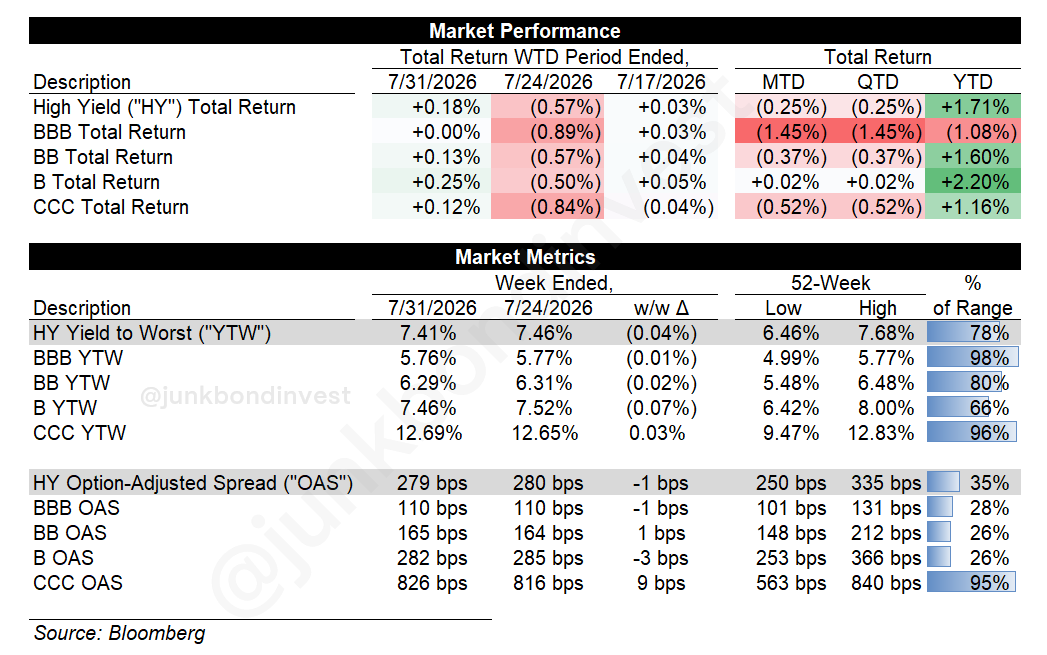
Market Performance
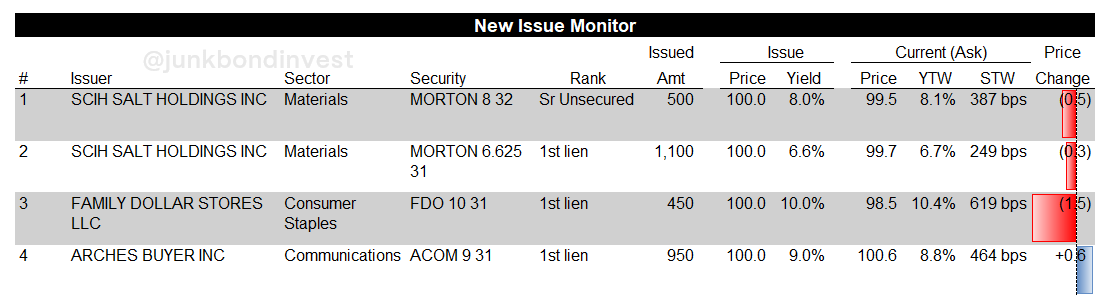
Primary Market Issuance
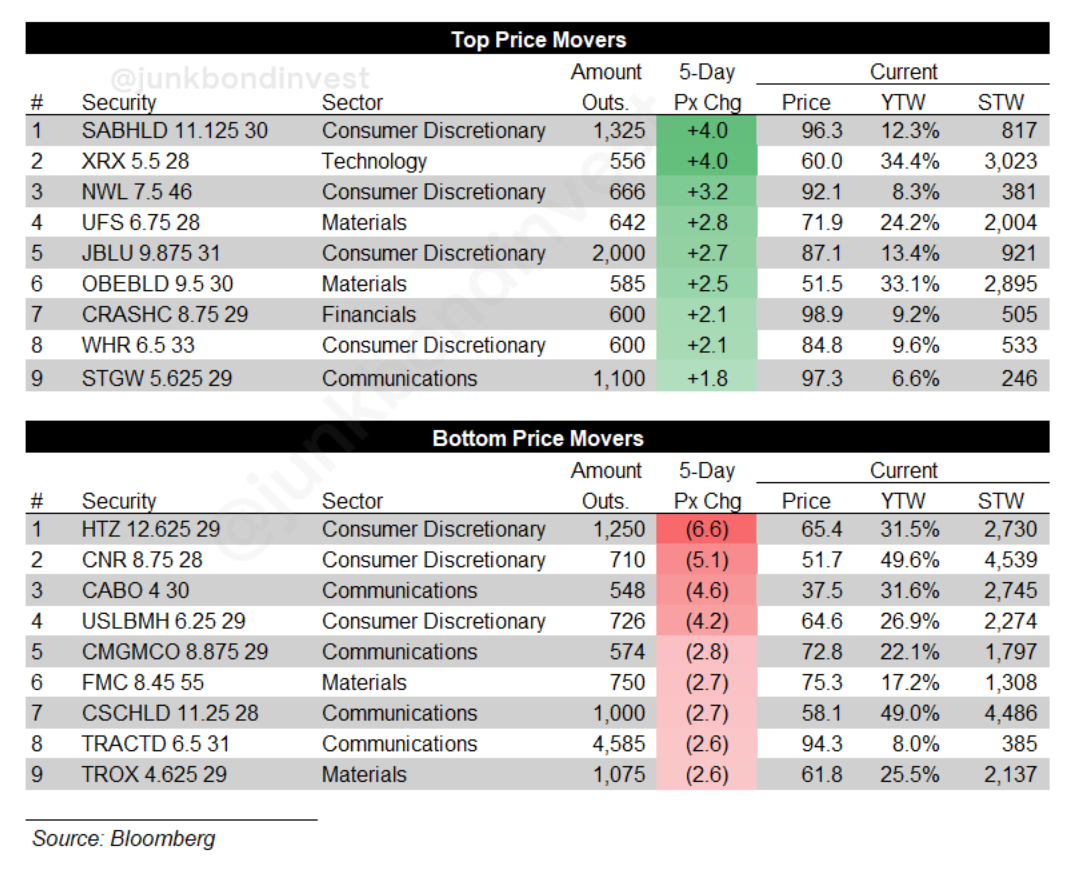
Secondary Market
JBI Bulletin Board

1) Now Hiring: Credit Analysts
I’m hiring credit analysts to add capacity. If that’s you, or someone you’d vouch for, reply with a short note on your background. For non-credit role inquiries, please see the following page.

