

Credit Weekly: Repriced, Not Differentiated
Every data center bond is called contracted. The documents allocate delay very differently, and the market is still pricing off the tenant curve.
Every desk note this week will tell you AI credit is widening on supply. They are right but it is the least useful thing you will read.


Look at 30-year hyperscaler debt (which has widened more than 3 standard deviations this month). First it was Nvidia which brought $25bn of new supply. Then SpaceX with $25bn the week after. Amazon also issued $25bn after that, and those are trading roughly 50bp back in secondary.
AI-related issuance across IG, high yield and loans now sits at a whopping $489bn YTD vs. $322bn for ALL of 2025. It’s also 23% of USD IG gross supply this year. The 6 biggest tech names carry more risk in the US high-grade index than the 6 biggest banks (the first time that has ever happened).
Base rates are clearly doing damage underneath it. 30 year treasuries are above 5% with real yields approaching 3%, so long-duration credit reprices regardless of what any individual issuer does. Both the governments AND hyperscalers are competing for the same long-end buyer. This is about absorption, not fundamental deterioration.
The more interesting part worth thinking about is what is actually happening underneath.
Project finance paper will not necessarily price on its own. A data center bond leased to Meta gets quoted off Meta’s curve + a premium for structure, tenor and complexity. So when the tenant’s curve widens on supply, the project paper widens with it, whether or not anything about the project changed. Take Hyperion for example, the $27bn Meta package done with Blue Owl last October, priced at par, traded above 109, and sits around 95 now.
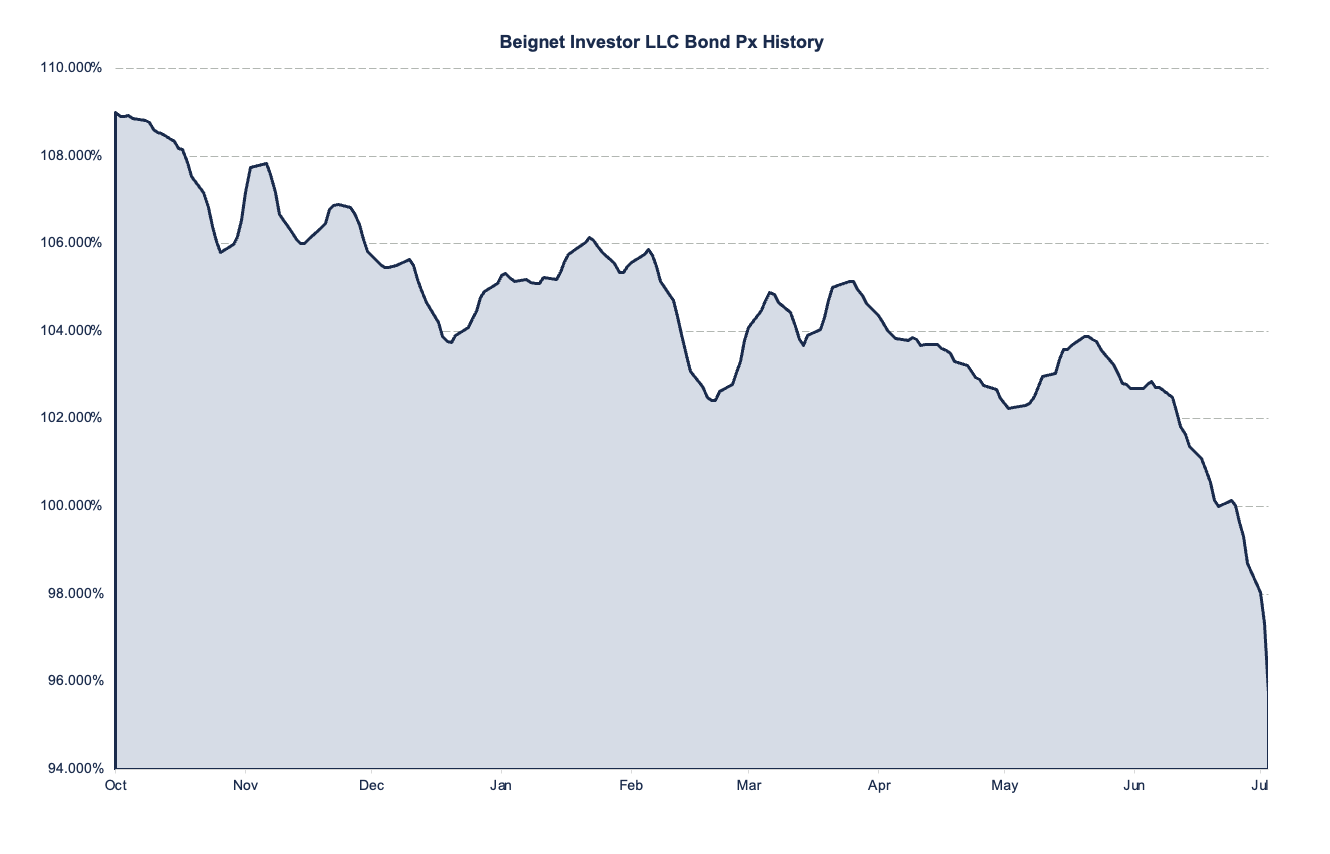
Of course some of the move is just duration, some is supply, and the price alone tells you almost nothing about how much of it reflects the structure.
Which is the problem. Everything is widening together but very little is being separated in the move. When rates and supply are pushing the whole complex around, price stops telling you what you own. The terms are the only thing left that can, and the premium over the tenant’s curve is supposed to compensate you for whatever sits between you and the tenant.
That is why the recent move is more interesting. Project-finance AI bonds are widening mechanically with their tenants, but the market is still not distinguishing between structures that place completion risk on the hyperscaler and those that leave it with the bondholder.
Besides tenant counterparty risk, what bondholders should be asking is what happens if completion slips and who has to fund the gap? Right now, the market is not paying nearly enough attention to the difference.
Free Issue Sponsored by 9Fin:

New report: Where is risk building across BDC portfolios?
9fin has analysed filings from 157 BDCs to produce an industry-first watchlist of potentially at-risk loans.
The report identifies:
468 individual loan positions showing signs of potential stress
$5.7bn of loans at fair value
$1.2bn of value erosion from $6.9bn of par value - roughly 17%
See which borrowers and lenders are exposed, where value is deteriorating and where pressure may emerge next.
The Same Word Has Different Meanings
Every lender deck in this sector says they have a lease that is “contracted” but “contracted” means very different things depending on who the issuer is.
Take the Meta (Sopaipilla) deal from last week because it shows what the strong version looks like. This is a $12.3bn senior secured note due November 2048, funding a 960MW campus in El Paso. Construction started October 2025 with rent commencing in December 2028. It’s about 3 years and change before the first dollar of revenue actually hits.


Here is what the documents actually say. Meta begins to pay rent from December 2028 whether or not the campus is finished. An abatement applies ONLY for force majeure, a landlord-caused delay, or if landlord tells the contractor to stop. The whole thing is capped at $218mm against the delay start-up insurance. Meta also agrees to cover cost overruns past 105% of the fixed budget. This is why the transaction is not exposed to typical construction risk. The tenant is taking that.
Beignet, the earlier Meta deal, worked the same way. Date-certain rent commencement.
Now the other end of the same cohort. The Hut 8 transactions, River Bend and Beacon Pointe, were the first where cash flows don’t commence until the data center is actually complete. Rent starts on delivery, not on a date. Completion risk moved from the tenant to the bondholder, in named deals, inside twelve months.
That isn’t just a slightly weaker version of the same bond. In the first structure you’re primarily exposed to the tenant’s contractual payment obligation, subject to whatever structural and enforcement risk sits above it. In the second you’re also exposed to construction execution, interconnection, equipment delivery, customer acceptance, and the project’s ability to stay liquid until rent begins.
What hasn’t happened is the same distinction being remade in the recent move. Tenant curves widened on supply, project paper followed mechanically, and structurally opposite deals moved together. A broad supply-driven selloff won’t separate them for you.
Why The Difference Matters
Because a signed lease is not revenue. Just like how a planned megawatt is not capacity or a hyperscaler tenant is not a powered site. Until a facility is fully energized, accepted AND billing, you’re lending against the conversion of a development project into an operating asset.
The reason this all matters is because the delivery dates will inevitably slip. Goldman expects only around half of scheduled capacity to arrive on time over the next two years.
From a credit perspective, a delay is not inherently a credit default. Nothing in the indenture trips because the interconnection date moves by 6 months.
The consequences rest with what’s been negotiated in the lease agreement. Commencement mechanics, delay penalties, rent deferrals, acceptance tests, customer remedies, termination rights, etc.
A delayed project can push out when rent starts, trigger customer remedies, and force amendments without ever having missed a coupon. The project doesn’t need to fail either for the bond economics to deteriorate. They can arrive late enough that the original cash-flow assumptions stop working. The difference is a hyperscaler can absorb that on its balance sheet; while the others have potentially limited liquidity.
There’s currently about $45bn of datacenter high yield paper that will mature between 2030 and 2031. If we take a typical 5-year bond issued against an asset expected to energize only in 2028, this leaves only 2 years of operating history before actual maturity. In practice, refinancing discussions typically start 12 to 18 months early, so the next lender will have only 6 to 12 months of stabilized performance in their underwriting. Now if the delivery date slips by 1 year, almost none of that remains. The delay ate into any refinancing cushion.
What Completion Risk Looks Like
Completion risk is easiest to understand by example. This one is worth watching precisely because it is not a marginal project.
Project Jupiter sits on 1,400 acres in Doña Ana County, New Mexico comprising 4 buildings, up to 2.45GW, and up to $165bn of announced investment. STACK Infrastructure and BorderPlex Digital Assets are building it, Blue Owl is the equity, and Oracle is the tenant.
The campus is designed to be fully powered by an on-site microgrid rather than relying on the grid. In late April, Oracle and BorderPlex said the energy plan had changed so that Bloom Energy fuel cells would replace the gas turbines and diesel generators originally proposed. A cleaner permitting story.
This is where it gets complicated. Energy Transfer’s Green Chile Project, a 17-mile extension, needs rights-of-way across state trust land. In March the State Land Office canceled applications for 2 crossings and a meter-station lease. Energy Transfer requested reconsideration and the Land Office denied that on July 14.
This is not a pipeline that has been rejected outright admittedly. The current route still lacks two state-land crossings and a meter-station lease, and the stated August 15 in-service date is now weeks away. Oracle’s own FERC submission said that missing that date would substantially increase costs and could jeopardize the campus operating timeline.
That does not prove the project misses its customer delivery date. However, the original delivery schedule appears increasingly hard to reconcile with the public record, which is a different and more useful observation.
Notice what is not failing. The construction is moving and the buildings are going up. What has run into trouble is a second, separate piece of infrastructure the first one cannot operate without. Project-on-project risk, where permitting, land access and construction all have to land twice. The building can be ready while the power is not.
What this project shows is that delivery risk can be visible in permitting and land records long before it appears in an issuer’s reporting. Importantly, sponsor quality and deep capital do not eliminate it. Instead, they just determine how much room a project has to absorb it, and who ultimately bears the cost.
I do think it’s important to highlight that the current issuance cohort is too young to offer much realized loss history. Most of the paper was issued last year against assets expected to energize in ‘27/’28 so the first test is on the come. That doesn’t mean you shouldn’t differentiate now. It just makes the documents more important, because the lease mechanics, the reserves and the completion schedule are the only evidence that exists before operating performance does.
In fact, industry participants are saying this out loud. CoreWeave’s VP of strategy made essentially the same point: compare the announced delivery date with how long the project should actually take to build, then mark the date on a calendar. Before there is loss history, the calendar is the early warning system.

New Mexico is also not the only jurisdiction where this happens, and in places the slowdown is deliberate. New York’s temporary pause covers any facility or group of facilities on the same or contiguous sites that can consume at least 50MW, so splitting a development into phases does not necessarily get you around the threshold. Fourteen states have considered statewide moratoria. New York is the first to impose one.
For a hyperscaler, a delayed project may be simply a portfolio management problem. Capacity can move to another site or another market. For a levered developer however, the same delay can consume interest reserves, push revenue to the right and become a liquidity problem. The same physical event can produce a completely different credit consequence depending on who owns the delay.
What Bondholders Should Underwrite
When does rent begin? A fixed contractual date provides very different protection from a lease where rent is contingent on completion, energization or customer acceptance. That nuance separates Sopaipilla from River Bend. In one structure the tenant starts paying even if the project is late. In the other, the project has to keep funding itself until the facility is delivered.
Next is who funds the delay. Look for the rent-abatement cap, the cost-overrun threshold, delay insurance, reserve sizing and any right the tenant has to terminate. An IG hyperscaler does not protect the bondholder from schedule risk if the project company still has to carry the interest, construction costs and lost revenue until completion.
Some additional non-obvious items you should be sure to ask when doing your diligence:
How much of the long-lead equipment has actually been ordered, and how much is on site?
Where does the project sit in the interconnection queue, or if it runs behind the meter, where does the on-site generation stand in its own permitting?
What still has to be permitted, financed and built that is not the data center itself?
What remains outstanding on the construction payment schedule?
What triggers the tenant’s termination rights, and how much cushion is there
How much room is left between the announced delivery date and the first refinancing conversation?
A campus that is energized and operating is a different credit from one carrying 2 more years of construction and an unresolved power dependency, even when the same name appears on both leases.
That brings this back to where it started. Spreads across the AI complex are wider, and much of the move can be explained by supply, duration and project paper following its tenant’s curve. Those forces reprice the entire complex, but they do not tell you which bond is carrying the better structure.
That main difference still has to come from the documents. A bond where the tenant has a fixed date rent payment and a bond where the project funds itself until delivery may share the same tenant and sector but they are not the same credit risk profile.
Microsoft, Meta, Amazon and Apple all report in the coming week, and everyone will be watching the capex line. But capex only tells you how much money is being committed. It does not tell you when the capacity turns on, how much liquidity gets consumed before it does, or who owns the delay when it does not.
JBI Bulletin Board

1) Now Hiring: Credit Analysts
I’m hiring credit analysts to add capacity. If that’s you, or someone you’d vouch for, reply with a short note on your background.


The depth and granularity of your research is fascinating.
Funny to find out this on the Project Jupiter website:
Project Jupiter Will NOT:
- Increase electricity bills for New Mexico residents or businesses
- Use the Camino Real Regional Utility Authority’s (CRRUA) public drinking-water supply for anything other than office water use (kitchens, bathrooms, etc.) at the project site
- Use a water-intensive evaporative cooling system at the data center campus (a closed-loop system will be used instead)
- Require ongoing water use for data center cooling or power generation during normal operations
- Reduce availability or reliability of electricity
- Ask the County for funding; no public money will be borrowed or at risk
- Expose taxpayers to financial risk
Are these projects perceived negatively in the US among the general population?
Great note, I need to subscribe if you asre going to run a DC only stream on these prject finance structures. They need to be tracked and covenant matched. All cycles end with debt markets re-pricing risk first IMO.