

The Game Theory Behind Strategy's ($MSTR) Distressed Preferreds
$54 billion of Bitcoin, $1.75 billion of fixed payments, and the game theory behind who gets paid

Last November I asked whether Strategy could afford $736 million of preferred dividends. The number is now $1.75 billion. Here’s an update on what’s transpired since then.
The short version: Almost everything I flagged as a risk got tested. Bitcoin declined from $126,000 to $64,000. MSTR fell from $434 to $98 and the premium collapsed toward NAV, closing the equity flywheel that made every raise accretive. And the “never sell” identity, the thing Saylor could never afford to break?
He broke it. Selling Bitcoin 4 times since June. So much for “diamond hands.”

What’s more interesting is what he did on the way down. Any rational operator would’ve slowed the purchases when the premium died. Saylor sped up, and he funded it with preferreds that ballooned to $15.4 billion across 5 tranches, now trading at prices that range from near par to distressed.
The quick read on those prices is seniority. The deeper read is the documents, because nothing in this stack ever matures, nobody can force a payment, and what management does with paper it wants to retire looks nothing like a traditional payment waterfall.
And this stopped being theoretical when Bloomberg reported distressed funds were talking to Strategy’s bankers about swapping their paper. Somebody has already done the reading. If you’re new to the story, read this primer to get up to speed.

Background
Strategy (formerly known as MicroStrategy) is the largest corporate holder of Bitcoin and at this point, really a publicly traded Bitcoin fund that finances itself in the capital markets. For a while, the financing was the easy part.
The machine ran on one key input: MSTR 0.00%↑ trading above the value of its holdings. Sell stock above NAV, buy more Bitcoin, grow Bitcoin per share, do it again. As long as the premium held, every raise was accretive.

Then Bitcoin rolled over, peaking near $126,000 in October 2025 vs. $64,000 today. MSTR followed it down, $434 in July 2025 to $98 today, with the premium compressing towards parity.
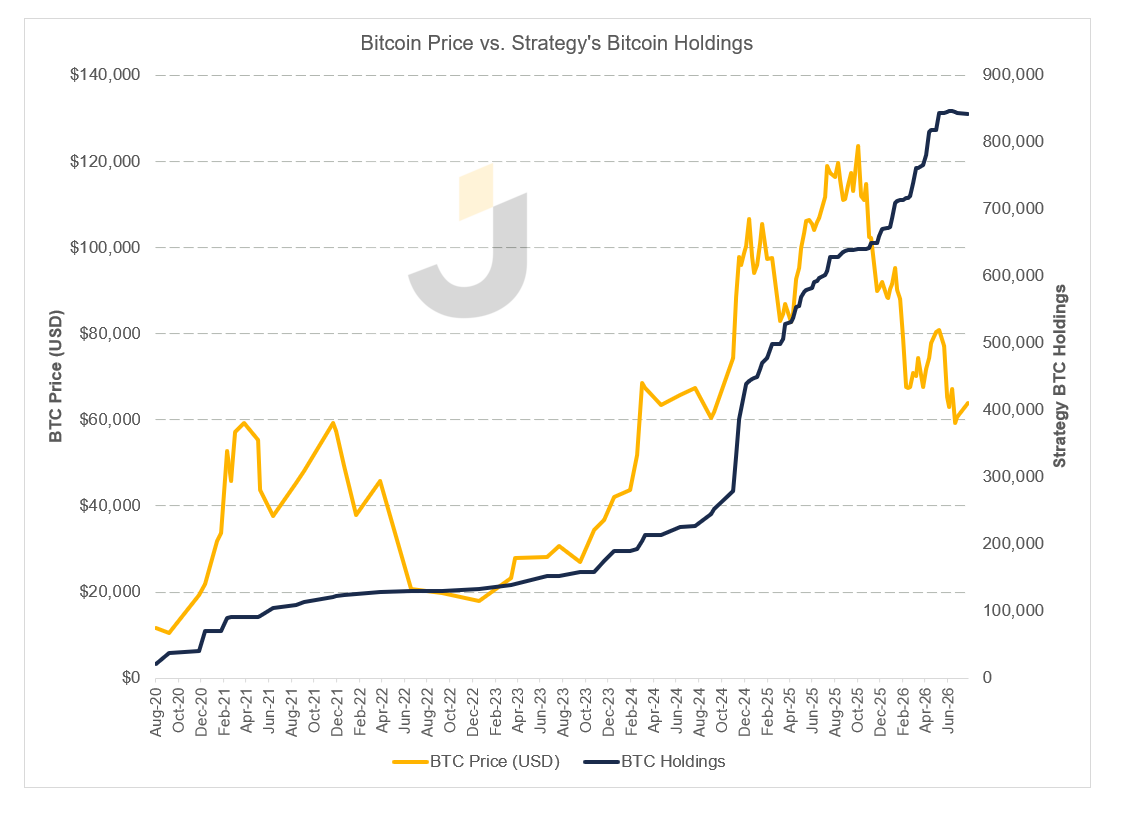
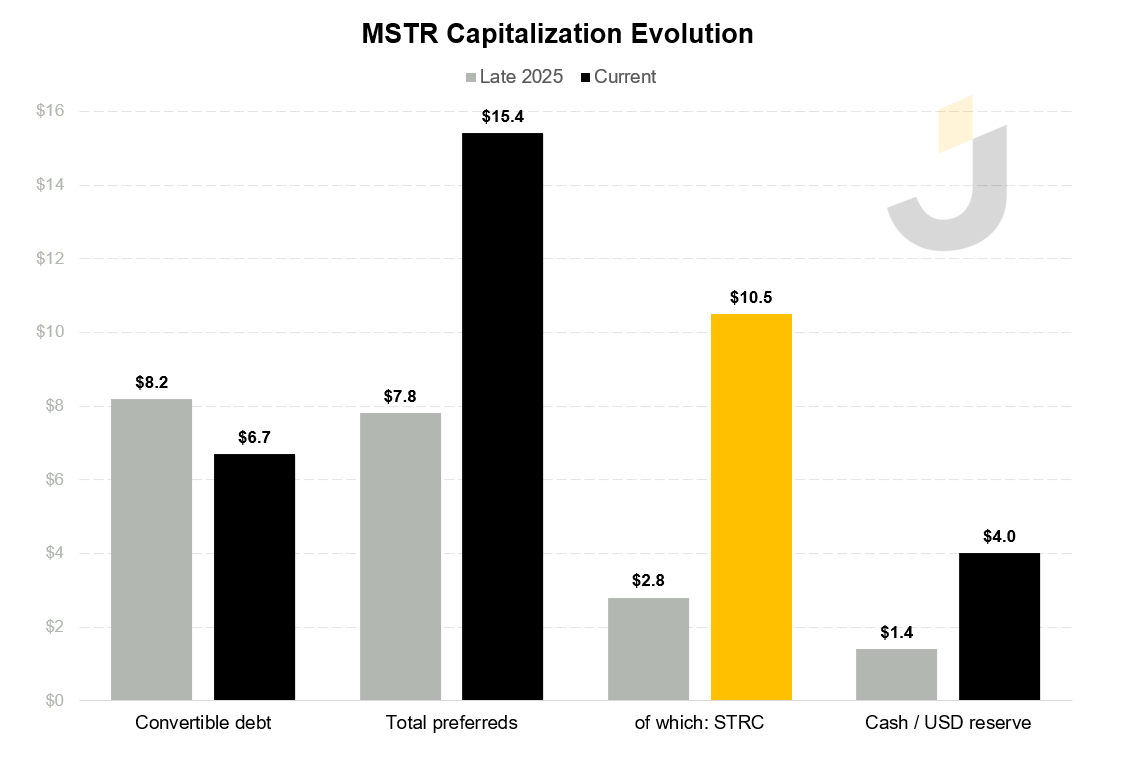
Holdings grew from roughly 650,000 coins to 842,139 through the decline. The money to fund these purchases was split between common stock and preferreds. On the preferred side, one security did nearly all the work: STRC, the variable-rate cumulative preferred. STRC went from $2.8 billion outstanding last fall to nearly $10.5 billion today. If you’re not familiar, STRC was supposed to be managed around par meaning that if it ever traded below that, management would increase the coupon to entice investors.
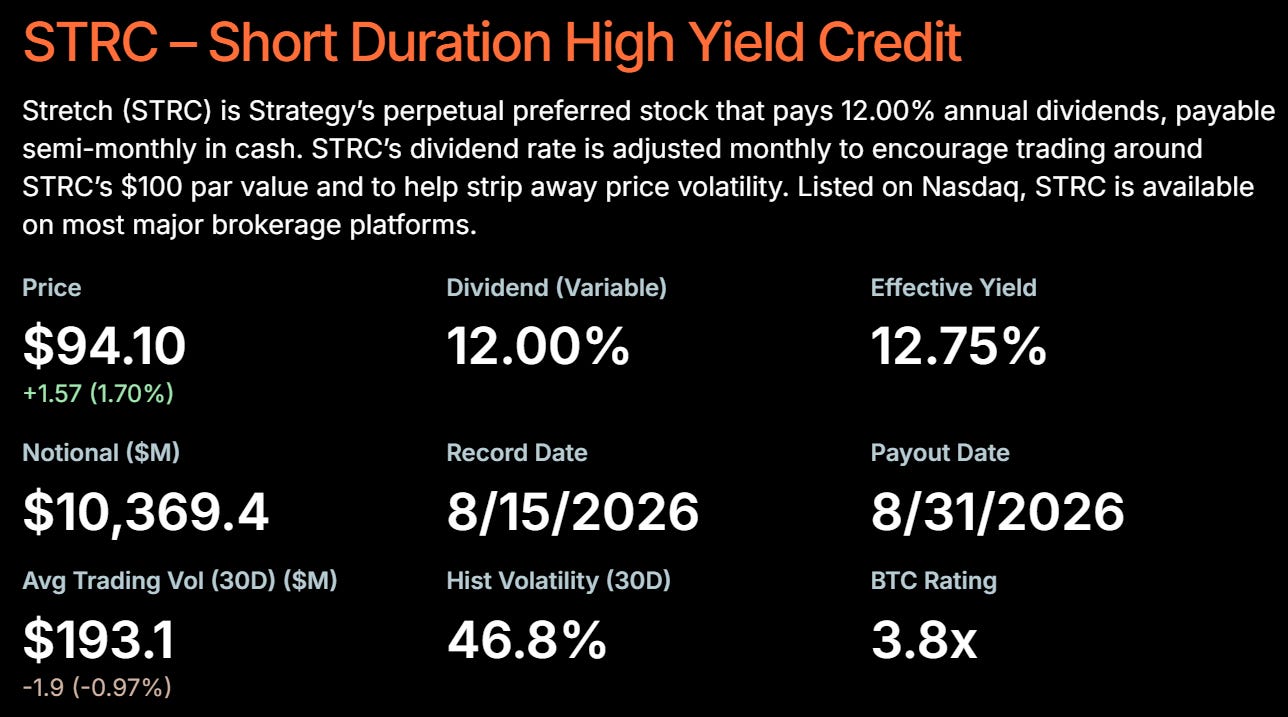
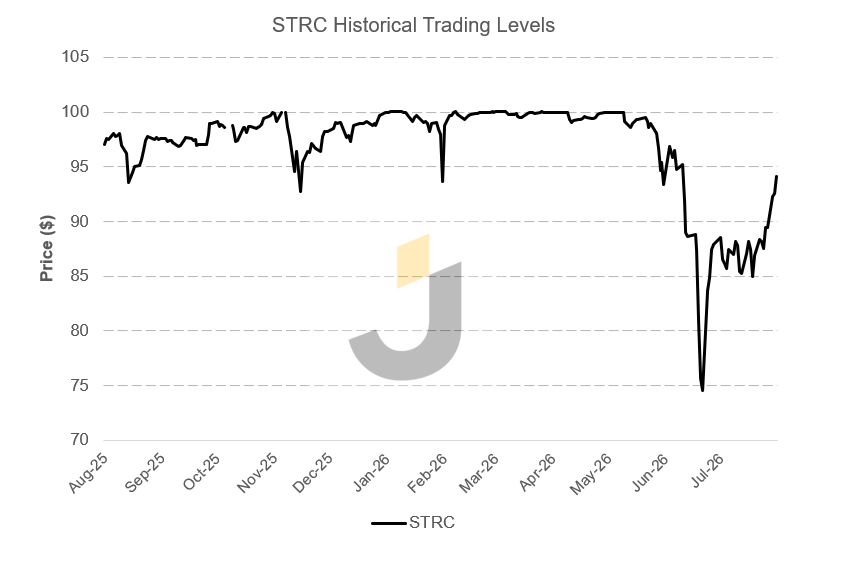
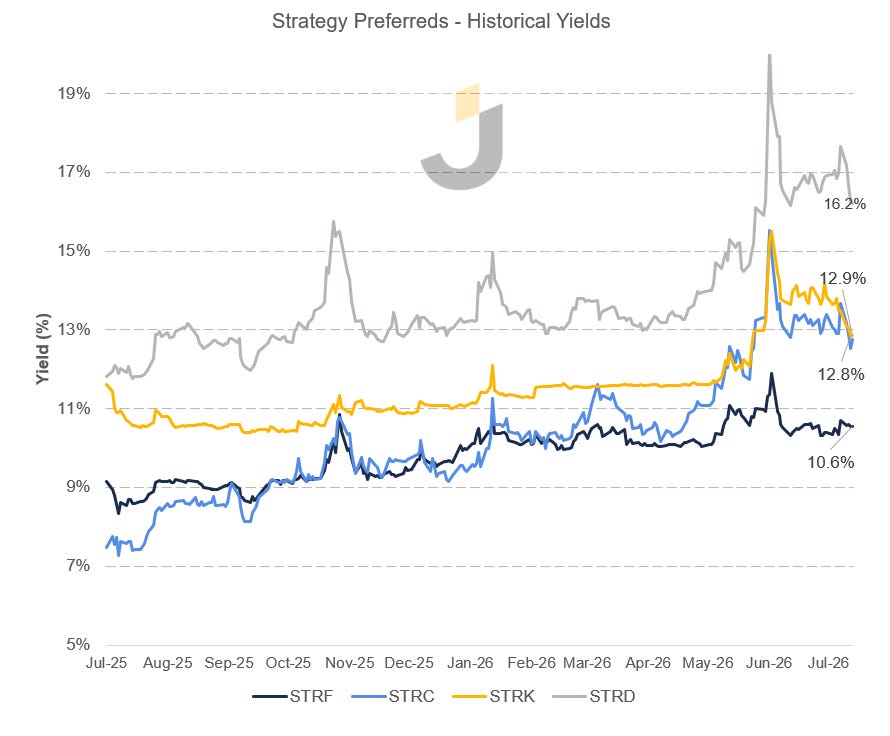
7 raises took the rate from 9% at issue to 11.5%, and the price still traded as low as 74 this summer. Management attributed the worst of the decline to broker-dealers pulling leverage from STRC holders, setting off forced sales into an already weak market. A 12% rate, a rebuilt reserve, Bitcoin sales, and a $1 billion repurchase authorization helped restore confidence and pulled the price back to 93 for a 12.9% current yield. The rebound was mainly sponsorship and the reversal of a technical liquidation, not the extra coupon. And every 100 basis points on $10.5 billion now costs the company $105 million a year.
The preferred dividend obligation is now about $1.75 billion so the natural question is how he pays it since Bitcoin produces no cash flow. Strategy sells common stock, parks the proceeds in a USD reserve (that started at $1.44 billion last December) and writes the checks from there. As the reserve drains, it gets refilled with more MSTR, more STRC when it trades near par, or Bitcoin sales. The circular logic is quite a feat in itself. They issue stock to hold cash to pay dividends on preferreds they issued to buy Bitcoin, and every link works as long as somebody keeps buying the next piece of paper.
Today, the reserve sits at $4 billion (USD) which buys time but it doesn’t make the structure self-funding. Issuing more STRC increases the dividend by $120 million for every $1 billion raised, so eventually the payments have to come from common shareholders, Bitcoin sales, or a reduction in the obligations themselves.
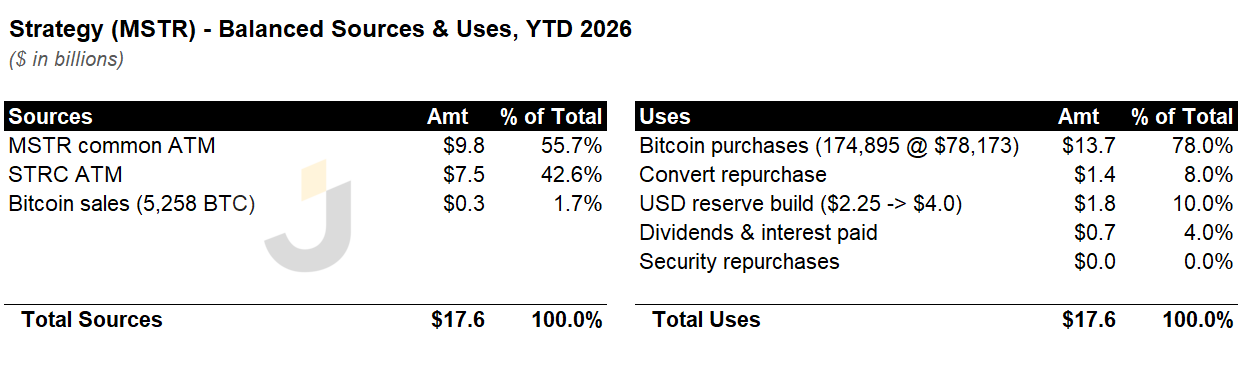
In May 2026, part of that reserve also went to repaying debt. Strategy repurchased $1.5 billion of the 0% converts due 2029 for about $1.38 billion, an 8% discount to par. The repurchase took convertible debt from $8.2 billion to $6.7 billion, and management says it wants to keep shrinking the converts rather than adding to them. Fine. But watch what grew in their place. The preferred layer now totals $15.4 billion. Strategy swapped low-coupon debt with real maturities for high-coupon paper that never comes due. Less refinancing risk but also substantially more cash out the door every year.
The preferred market spent the year pricing that trade despite not one dividend being missed. Part of the spread is legal. The waterfall runs STRF, then STRC, then STRE, then STRK, with STRD at the bottom, and STRD is noncumulative, meaning the board can skip a dividend and never owe you the skipped amount. The rest is sponsorship. STRC is the flagship management wants to scale. The others increasingly look like leftovers from Strategy’s experimentation with different versions of “Bitcoin credit.”
Strategy currently carries $6.8 billion of debt and $15.4 billion of preferred stock against $54.2 billion of Bitcoin and $4.0 billion of cash. Bitcoin and cash cover the entire debt/preferred stack about 2.6x, leaving roughly $36 billion of residual value left for the common, and MSTR’s $37.6 billion market cap trades modestly above it.
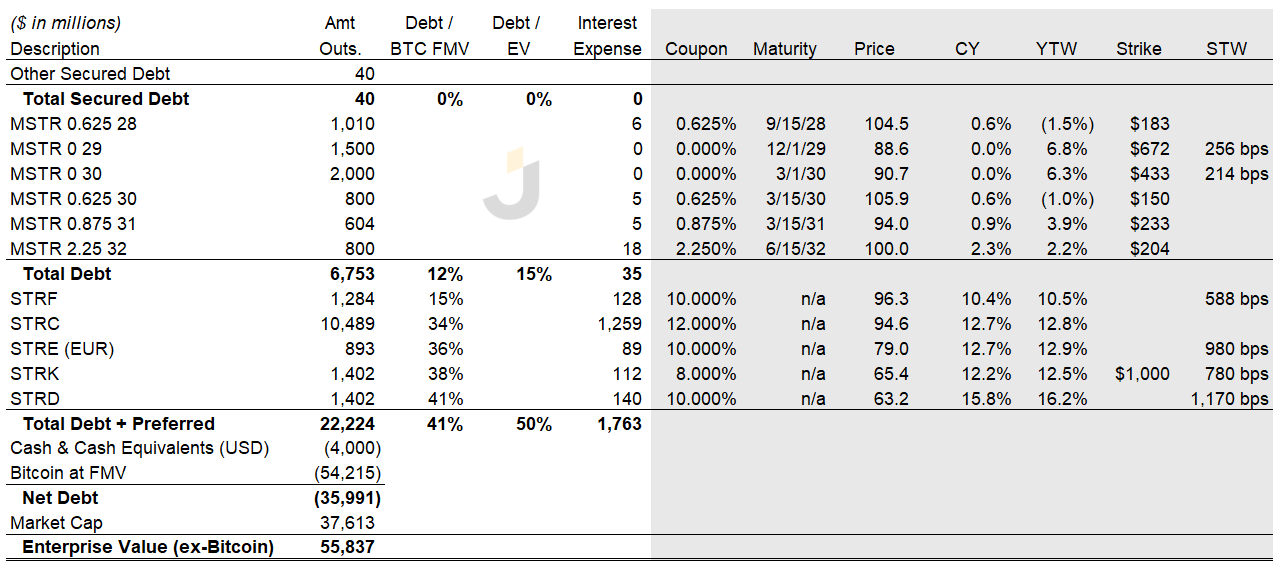
Saylor has time, just not unlimited time. At current levels the cash covers the preferred checks for 2+ years without raising another dollar. The converts are the more immediate concern. Puts start in September 2027 and run through 2029, $6.7 billion in total if nothing equitizes, and with MSTR trading around $98, even the lowest conversion price remains out of the money. This paper will need to get refinanced, repaid, or repurchased, and every path costs money.
Saylor’s Financing Plan Going Forward
So what’s the plan? There are two real changes in direction, both new.
No more net new bonds. Saylor has said that if he were rebuilding the capital structure today, he’d skip the converts and go straight to STRC. Refinancing remains available if a convert put has to be addressed, but management no longer wants the debt stack to grow.
And no more automatic all-in allocation. Management now admits that putting every dollar raised into Bitcoin left the structure too exposed. Future proceeds will be split between Bitcoin and cash based on market conditions, with the USD reserve targeting 2 to 3 years of dividend and interest coverage and 1 year as the minimum. Better for the preferreds, less amplification for the common.
But why fund a Bitcoin balance sheet with 12% money when convert buyers were happy at zero?
Because STRC has no recurring principal claim. No maturity to refinance, no put to fund outside a fundamental change, and no missed-payment default that hands holders a seat at the restructuring table. Skip the cumulative dividend in a true emergency and it accrues, but nobody can accelerate the principal. Converts are cheaper until the day they mature into a weak market, and Saylor has decided he’d rather never meet that day. Expensive capital that can’t force the issue beats cheap capital that can.
The plan needs STRC back at $100, because near-par, low-volatility trading is what makes it issuable at scale. Get it there and the capacity is real: Strategy sold as much as $2 billion of STRC in a month during stronger periods, and Saylor believes $1 billion a month is sustainable in a normalized market.
The economics depend on which security you own. For the preferreds, Strategy only needs enough liquidity to keep making the payments. For the common, Bitcoin has to outperform the cost of the capital used to buy it, and future issuance can support the carry but cannot turn negative spread into value creation.
Management’s own numbers frame both: at ~3.2% annual appreciation, Strategy can sell enough coins to cover every dividend and interest payment without shrinking the dollar value of its holdings, although the coin count still declines, and roughly 10.8% is where the leverage earns its cost. Between the two, the bills get paid but the financing produces little incremental value.
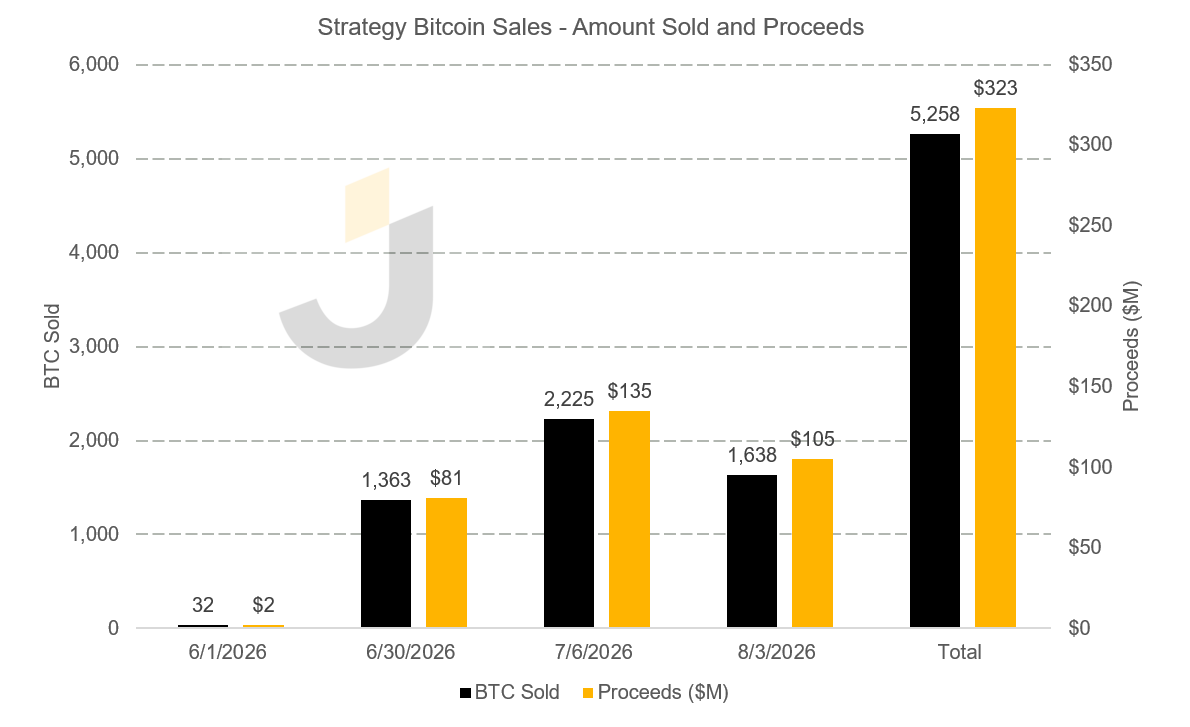
Selling is also no longer hypothetical. Strategy has sold Bitcoin 4 times since June, starting with a 32 coin trial balloon and escalating through early August (5,258 coins and $323 million in total). For the preferreds and converts, a management team willing to monetize Bitcoin rather than defend the “never sell” narrative trims real tail risk.
The plan is less fragile than the annual obligation makes it look and more dependent on capital markets than the asset coverage suggests. It’s also why the smaller preferred dividends keep getting paid: suspending one saves relatively little and damages the STRC market that funds everything else. The machine works while at least one of three channels remains supportive: MSTR above NAV, STRC near par, or Bitcoin salable at an acceptable price.
What Happens If Bitcoin Stays Down?
This is where it gets interesting and the scenario that everyone’s worried about. What happens if Bitcoin just stays here, or grinds lower, for 2 more years? What if the premium never comes back, STRC can’t get to par, and the reserve drains with nothing refilling it?